
I've just started to read a book on Benjamin Franklin, titled
Bolt of Fate: Benjamin Franklin and his Electric Kite Hoax (by Tom Tucker). The book basically argues that Benjamin Franklin never conducted his famous electricity experiment, in which he flew a kite during an electrical storm. I haven't gotten to the bulk of the argument yet, nor have I decided whether I buy into this author's argument. But I was interested to learn that very soon after Franklin was extolled for his experiment in May 1752, a scientist in Russia tried to replicate Franklin's experiment, and ended up dying.
1 According to Tucker, Franklin histories have dismissed this Russian man as "foolishly unaware," but "Russian and Estonian sources...reveal the victim to have been a brilliant, very aware scientist...and a skilled linguist who followed Franklin's every word in English."
2 Hmm. So can one really survive flying a kite in an electrical storm?
Although I'm not very far into the book, I have been most amused by its discussion of
Poor Richard's Almanac. I knew that Franklin published this almanac under the pseudonym of Richard Saunders, but I didn't know much else about the publication. I had no idea it was so humorous!
Poor Richard's Almanac burst onto the market by predicting the date for when his competitor Titan Leeds (another almanac writer, who did not publish under a pseudonym) would die. This publication caused a lot of back-and-forth writing between "Saunders" and Leeds over the next few years. You can read a little bit of the episode on pages 7 -10 the
Electric Kite Hoax book (see
here). I laughed out loud when I got to the top of page 10. Franklin was quite clever.
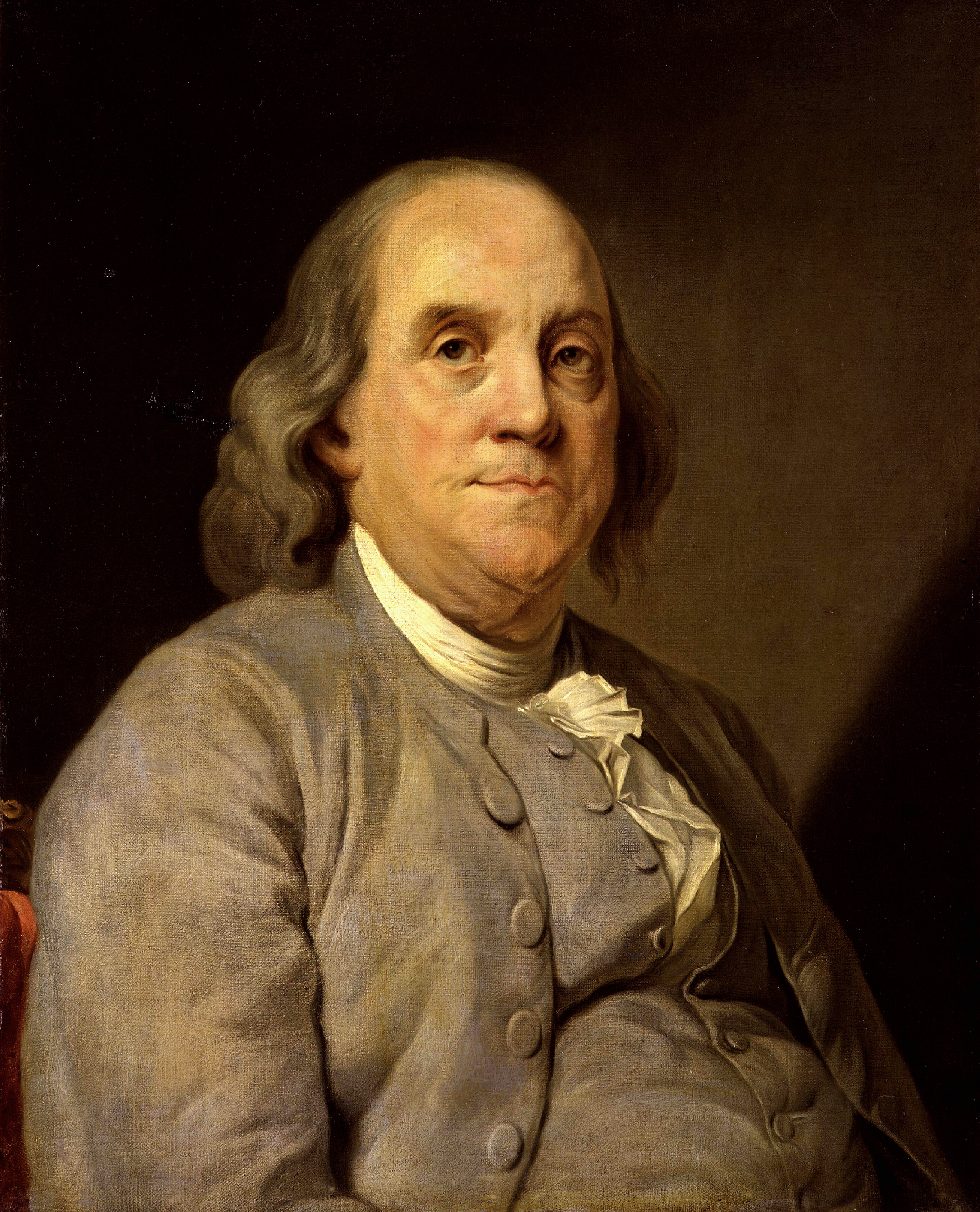
The portrait of Ben Franklin was painted by Joseph Siffred Duplessis, c. 1785. For more information on the portrait, see here. Image courtesy of Wikipedia.1 Tom Tucker, Bolt of Fate: Benjamin Franklin and his Electric Kite Hoax (New York: PublicAffairs, 2003), xix.

 Sam has become rather interested in knights, ever since we showed him "Bedknobs and Broomsticks" a few months ago. But unfortunately the end of the movie (see a clip here) really affected Sam's definition of what constitutes a "knight." For a few weeks after seeing that show, Sam kept telling me that "knights don't have heads." Oh dear!


 Posts
Posts


