Showing posts with label jimmy stewart. Show all posts

Friday, September 26, 2014

King of Jesters!


Since I discovered the blog The Danny Kaye Show a few weeks ago, I decided to read the biography of Kaye that was written by the owner of that blog, David Koenig. I liked the book Danny Kaye: King of Jesters alright, although I do wish that there was a little bit more information about Danny's personal life and friendships. Instead, this book focuses on Danny's career, with comparatively limited discussion of Kaye's personal life. Kaye's relationship with his wife, Sylvia Fine, is discussed in detail quite a bit - which makes sense, since Fine's musical compositions, lyrics, and overall micromanagement of Kaye's work was a large part of his career. I don't think that this book would be interesting to the casual reader, but it was interesting for me to learn more about many of the films that I enjoy so much.

I also discovered some interesting things about Kaye's career and work, and I also learned about some films and performances that I have never seen (yet!). Here are several things that I found interesting in this book:
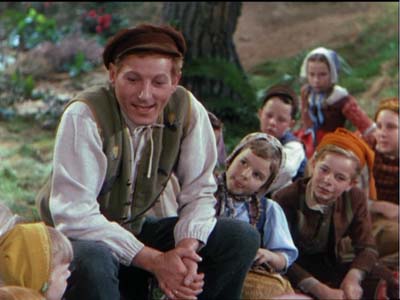
  • Danny coveted the role of Hans Christian Andersen until it was given to him. Another actor who was really interested in this role was Jimmy Stewart. Stewart’s interest in the film helped in the negotiating with Kaye, since Kaye was a more natural choice (Koenig, p. 145). Can you even imagine Stewart as Hans Christian Andersen? He would be personable and lovable, of course, but his slow drawl would seem a little absurd to me in this context: "Well...once...there was...an ugly duckling..."
  • Perhaps, since I have a little baby right now, I was touched to read about how in a stage performance in Omaha, Danny finished singing the final number when a baby, who was seated with his mother in the front row, started to cry. The mother couldn't quiet the child, and Kaye announced from the stage that he would sing one more song: a lullaby. He walked down to the baby in the front row, picked it up, and went back on stage. As Kaye sang, the child slowly grew quieter, and finally became silent. Upon finishing the song, Kaye put a finger to his lips to prevent the audience from applauding. He quietly returned the baby to its mother and then, still with a finger to his lips, walked back up on stage and off into the wing. The child slowly grew quieter and finally silent. Kayte put a finger to his lips to stop any applause and quietly returned the baby to its mother. Danny, still with a finger to his lips, walked back up on stage and off into the wing (Koenig, p. 156-57).
  • The song “Willow Willow Waley” was pared down in length and “Pass the Basket” was entirely cut from The Court Jester. Danny still recorded a full version of these songs as well as “I Live to Love” and “Where Walks My True Love” (recording by Jeri Southern HERE). The latter was another song that was cut, but does appear as instrumental music when Hawkins is traveling in a cart with Maid Jean (Koenig, p. 176-77).  
  • I was interested to read about how Kaye wanted to set himself apart from Jerry Lewis. In a sketch with Lucille Ball on The Danny Kaye Show, there is a scene when they are getting progressively drunk. Kaye was letting the food slop out of his mouth during rehearsal, and the producer Oppenheimer said, “'Well, [that’s] something I would expect from Jerry Lewis, but not from Danny Kaye,'” and he just froze over and turned on his heel…but by golly, he turned over and took all of the gross stuff out. And maybe ten times after that, during the course of the show, any time there was a little discussion or something, he’d say, 'Do you think that’s maybe what Jerry Lewis would do?' So it really touched him" (Koenig, p. 209).
  • Can you imagine Kaye as Professor Harold Hill, Tevye, or Professor Higgins? "Over the years offers...trickled in [for Kaye] on Broadway, such as originating the lead roles in The Music Man in the 1950s and Fiddler on the Roof in the 1960s, and filling in for Rex Harrison in My Fair Lady for three months" (Koenig, p. 259).
  • Kaye did the voice for the narrator in Here Comes Peter Cottontail, an animated classic by Rankin and Bass. This film never reached the same amount of popularity as the claymation Christmas TV specials by Rankin and Bass.
  • Kaye played Captain Hook in Peter Pan in London. Mia Farrow played Peter Pan. The show was planned as a Christmas special and televised in London. It was taped 1975, and aired in 1976 on NBC (now available on YouTube) (Koenig, p. 268).
  • I love the expression of Danny Kaye's face in this photo. A copy of this photo appeared in Koenig's book. The biography explains how Kaye tried to create a persona for himself on stage which was so friendly and warm, to the point that the audience thought that they had really got to know who Danny Kaye was as an individual. Although Kaye seems to have been much more difficult and less personable in actuality, I like to think that the warm, kind person that he created on stage did exist within Kaye himself, or else he wouldn't have been able to portray it at all. In this photo Kaye appears with Victoria Paige Meyerink, a precocious four-year-old who appeared on Kaye's show several times (and received a lot of fan mail in the process!). I imagine that Meyerink has just said something amusing, and Kaye is looking out to the audience to connect with them in that amusement.

  • I was really surprised to learn that in the 1970s, Kaye took a break from show business to be a part-owner of the new Seattle Mariners team! Kaye owned several radio stations in Seattle too. After six losing seasons, though, Kaye sold his interest in the team (Koenig, p. 270). 
Since I started to read this book, I have also been interested in listening to a little bit of The Danny Kaye Show that aired on the radio in the 1940s. Episodes of this show are available at the My Old Radio and Radio Lovers sites. I don't think it's as fun to listen to Danny Kaye as watching him, but I still have a pretty good idea of the facial expressions and hand gestures that he might be using during the radio skits.

Tuesday, December 13, 2011

Christmas movies


This Christmas season has been especially fun with Sam this year. Now he’s old enough to appreciate a lot of the Christmas movies that Jeremy and I enjoyed when we were young. J and I have a lot of fun showing him different Christmas shows, books, and holiday-related activities that enjoyed when we were younger. We’ve also tried some new activities too, like going to the “Snowflake Lane” presentation (with a drum line dressed up like toy soldiers).

Here are the children’s Christmas shows that we have introduced to Sam this year:
The claymation Christmas movies, including Rudolph the Red-Nosed Reindeer, Frosty the Snowman, and Santa Claus is Comin’ to Town.
How Grinch Who Stole Christmas (see here and here)
‘Twas the Night Before Christmas (I don’t think I ever watched this show as a kid, but J watched it quite often.)

Sam especially loves How the Grinch Stole Christmas. We showed him the movie about the same time that we borrowed the Dr. Seuss book from J’s parents. Sam likes to reenact the Grinch’s movements while J reads the story. He especially likes to repeatedly pull down on an imaginary Max (see 5:32 of this clip), when the Grinch says, “It came without ribbons! It came without tags! It came without packages, boxes, or bags!” Oh, and he also likes to slither and slink around the Christmas tree like the Grinch (see 4:19 of this clip).

We also have had many-a-conversation about how the Grinch was able to lift the sleigh after his heart grew three sizes. I think Sam interprets the Grinch to be some kind of superhero.

I’ve enjoyed revisiting these children’s Christmas movies with Sam this year. It will be fun to introduce him to my own favorite Christmas shows, as he gets older. Two of my favorite Christmas shows are It’s a Wonderful Life and White Christmas. J grew up watching the musical Scrooge with his family; he always wants to watch that show before Christmas. (I know – it’s a shocker that my husband actually likes a musical.) He also likes to watch Edward Scissorhands sometime around the holiday season. So, I guess for us, Christmas isn’t complete unless we can celebrate with Jimmy Stewart, Bing Crosby, Danny Kaye, Rosemary Clooney, Albert Finney, and Johnny Depp.


What are your favorite Christmas movies (for the young and/or old)?

Wednesday, September 15, 2010

a few recent realizations

  • I don't really like romantic sub-plots in novels. I don't mind when characters fall in love, I guess, but sometimes I get annoyed when a book tries to interweave romance into an already-good story. I've just finished The Hunger Games, and I started to get annoyed when Peeta and Katniss began to deal with a lot of romantic silliness. I felt like the plot was great without all of that mushy stuff (but maybe I'll change my mind when I read the other two books in the series).
  • I don't know that much about recent film. Every couple of months I am reminded that I am completely ignorant on this subject. If someone wants to talk about movies created before say, Funny Girl (1968), I'm all there. I can talk a lot about Frank Capra, Cary Grant, Jimmy Stewart, Hitchcock, Audrey/Katherine Hepburn, and various old musicals. But I'm a deadbeat when it comes to conversations about recent movies. And to tell the truth, I can't tell if I'm totally bothered by my ignorance. I know that J and I could easily switch off our documentaries/foreign films/silver screen classics and watch something more recent or popular, but I'm not quite motivated to change.

Thursday, January 8, 2009

photography of sammy davis, jr.

One of my favorite Rat Pack singers is Sammy Davis, Jr. Not only is he a great singer and dancer, but he can do particularly good impersonations. (And no, we didn't name our son Samuel David after Sammy Davis!)

This is a really fun television clip that shows Davis' talent at impersonating singers and Hollywood stars. His impersonation of Jerry Lewis is pretty spot-on! I love his Jimmy Stewart impersonation too - it's almost disconcerting to hear Jimmy Stewart's voice coming out of someone else's mouth!


Last week my sister C let me borrow her copy of Photo by Sammy Davis, Jr. I didn't know this before, but Sammy Davis, Jr. was an avid photographer. This book by Burt Boyer is filled with photographs that Davis took at different parties, film sets, and public gatherings (e.g., one of Martin Luther King, Jr.'s speeches). There are candid photographs of several celebrities like Marilyn Monroe, Dean Martin, Jerry Lewis, Rock Hudson, Frank Sinatra, and Jacqueline Kennedy. Some of the photographs are quite artsy too, particularly ones of city life that were taken when Davis was on tour. The book also contains commentary by Boyer (a life-long friend of Davis) and also some excerpts from Davis' autobiographies (which Boyer and his wife co-authored with Davis). I think it's a really fun book - it's interesting to see the world of Sammy Davis, Jr. through his camera lens.

Wednesday, September 17, 2008

george washington and george bailey

I wanted to write down some thoughts about two books that I read earlier this summer, 1776 by David McCullough and Jimmy Stewart: A Biography by Marc Eliot.

1776 - As a historian, I thought that I would naturally be pleased with this book. And in many ways, I was. I enjoyed reading about lesser-known individuals that were involved with the Revolutionary War, such as Henry Knox and Nathanael Greene.

However, my main motivation for reading this book was to learn more about George Washington's character and personality, and I was disappointed to not find more information in McCullough's book (I guess I should have read a biography on Washington if I wanted to learn more about him, eh?). Earlier this spring, on a visit to Mount Vernon, I realized that George Washington is kind of an enigma to me. In fact, I could sum up my knowledge of him in a short list:
  1. Didn't chop down cherry tree, cannot tell a lie
  2. Likes to remodel Mount Vernon
  3. Owned slaves
  4. Married a rich widow
  5. Was a general
  6. Liked liberty
  7. Crossed the Delaware
  8. Wore dentures
  9. Didn't want to be president
Does anyone have anything else that they could immediately add to this list? If I made lists about the other founding fathers, such as Benjamin Franklin or Thomas Jefferson, I think they would be considerably longer. I could chat with Ben Franklin about bifocals or electricity, and it would be easy to talk to Jefferson about Neoclassical architecture or his work as an ambassador in France. But what would one chat about with George Washington?

Anyhow, it seems like McCullough also found George Washington's feelings and character a little hard to analyze; he used words like "imperturbable" to describe the general. It seems like the austere Washington didn't want to get too close to his men or associates for fear of losing respect and authority as general. Or, who knows - maybe Washington was an introvert?*

Aside from my Washington disappointment, I felt like the book was moderately engaging. It got rather dull in the middle when the troops kept losing battles in New York. But I guess McCullough wasn't at liberty (hee hee! And neither were the colonists!) to change history and spice things up a bit. I found myself hoping that Washington would cross the Delaware soon so that something exciting would happen...and so that the book would end and I could start this one:

Jimmy Stewart: A Biography - For anyone who likes reading about actors from the silver screen, this is quite an entertaining book. Not only do you follow Stewart's career in Hollywood, but you also learn more about the actors and actresses with whom he worked (e.g. Katherine Hepburn, Kim Novak, June Allyson, Cary Grant, Henry Fonda, etc.). I was also impressed to find out that Stewart appeared in about eighty films, not to mention his appearances in other short films and television shows.

Eliot does a good job of describing the plot, virtues, and shortcomings of many of Stewart's films. His discussions were so interesting that I immediately went out and rented Vertigo after finishing the book, partly to see if I agreed with his discussion of the film. (This is a great film, by the way. I highly recommend it.)

The thing that bothered me most about this book were all of the Freudian references and analyses. Call me crazy, but when I picked up this biography on Stewart, I thought that I would be reading about what it was like to play Jefferson Smith, George Bailey, and Elwood P. Dowd. I wasn't expecting to read someone's Freudian analysis on why and how Jimmy Stewart's wife Gloria looks like Jimmy's mother (they look nothing alike, by the way). It seemed like in the sections where Eliot was not able to gather a lot of historical information or evidence, he tried to flesh out the missing sections with psychoanalysis. Unconvincing psychoanalysis. Downright silly psychoanalysis. Don't get me wrong, I think that Freud's theories have plenty of value. But I feel like his theories were misapplied in this biography, and I think that Eliot is a little bit too concerned with sex in this book. Perhaps he felt like making the book "sexier" would have it sell better? Hmm.

One interesting thing I learned: Jimmy Stewart became increasingly deaf as he got older, which was said to have resulted from the filming of It's a Wonderful Life, when Stewart's character George Bailey jumps into the icy river to save Clarence. Isn't it ironic that Stewart began to lose his hearing after this scene, when in the film George Bailey regains hearing in his "sore ear" after saving Clarence and receiving his wish to have never been born? The character regains hearing when the actor really loses hearing.

And my final interesting discovery: Jimmy Stewart wore a toupee.

All in all, an entertaining book. Take out all of the Freudian blah, and this is a fun read.

*It really is a pity that Martha Washington destroyed all of George's letters to her (except for three letters which survived by accident). Although I can respect Martha's wishes to have her relationship with her husband kept private, as a historian I cannot help but lament. The loss of those letters makes the melancholic work of recreating a lost time period (a recreation that already only can happen with fragments of remaining historical evidence) even more melancholy.