Showing posts with label jerry lewis. Show all posts

Thursday, April 14, 2016

Celebrities Project: James Dean

I had hoped to write this post about James Dean a few weeks ago, but we recently returned from a vacation and I haven't had a chance to organize my thoughts until today. I also wrote a post on my art history blog about James Dean's interest in art, which is meant to complement this post. I feel like I have learned quite a bit about James Dean, mostly from reading the biography James Dean: The Mutant King: A Biography by David Dalton. This was a pretty good book, although sometimes it was a little redundant or unnecessarily Freudian.

In many respects, I feel like I understand James Dean and can connect with him: his mother died when he was nine years old, and although my mother died when I was in my late twenties, I think that we are both influenced by our mothers (both in their presence and absence from our lives). One cute anecdote from Jimmy's childhood was that he and his mother played a "Wishing Game" together: Jimmy would write a wish down on a piece of paper and place it under his pillow; during the night, his mother would remove the paper and try to make the wish come true the next day.

I think that James Dean reminds me a bit of the stereotypical thespian (or "drama freak") that you might find in high school: eccentric, aloof, with both a devil-may-care attitude and a slight disdain for those who follow the norm. In some ways I can relate to this type of person, since I had many "drama freak" friends in school and even referred to myself in that way (although I was a bit of a poser, since I mostly just participated in the annual school musicals). I feel like it's easier to think of him in this type of high school context though, because his poetry seems a little bit rough and overly eager. That being said, I think there are some nuggets of value in the poetry I did read. Here is one example of a poem which James Dean wrote, titled "Old Creek" (it reminds me a little bit of Mary Oliver's poems, with the interest in nature imagery):

I took a little drink from an ample stream
I fear thereby result in fertile jest to her source
Her current swift direct and crystal
There is a want to be there and drink long
Nature's plea, ovum, stem and pistil
But there is more to streams 
Than the water to gorge on
Plunge your face in a brook 
To wash the desire away
A fool to drink
To drink and not to taste.

It seems to me that James Dean was a very passionate person, and he wanted to wholeheartedly thrust himself into whatever he was doing or thinking at the moment. This is probably why he was a practitioner of the highly-personal acting theory called The Method, in which an actor tries to genuinely replicate and feel the emotions, mannerisms, etc. of the character that he/she is feeling. In other words, in many ways James Dean tried to really be his characters, and it sometimes took him hours to prepare for a shoot or performance.

I think that there is so much emphasis on the three major films that James Dean completed, that some of his other work gets forgotten. He not only had roles on the stage, but also had some minor roles in television and film. I was particularly interested to learn that James Dean served as an extra in Jerry Lewis and Dean Martin's film Sailors Beware (1952). You can see him in the clip below, as one of the supporting staff members at a boxing arena:


That being said, James Dean did make his biggest impact on America (and the world) through the three major films that he participated in. Here are just a few thoughts that I had on these films:


Rebel Without a Cause (1955)This movie has several intense moments! I think that James Dean has some very poignant acting moments, particularly in the opening sequence (which he improvised himself), and in the scene when he argues with his parents on the staircase. One thing that I was interested to learn was that this movie opened four days after James Dean died. Everyone wanted to be James Dean after this movie, and thousands of red jackets were sold from Mattson's, where the cast had bought their clothes off-the-rack (Dalton, p. 317).

East of Eden (1955): I think that this is my favorite out of James Dean's movies, perhaps because I really like the book by Steinbeck and I like the way that Dean portrays Cal Trask. I think there are some interesting expressions of emotion and frustration conveyed in this film. Probably one of my favorite things that I learned was that James Dean, as a Method actor, was compelled to deviate from the script during the scene when he tries to give his father money as a birthday present. The script called for Cal Trask to storm away in anger after his gift was rejected, but Dean felt compelled to try and hug his father. His co-star, Raymond Massey (who plays the father Adam Trask), was so shocked by this deviation from the script that he could only exclaim "Cal! Cal!"


Giant (1956): I thought James Dean was fine as Jett Rink in this film, although the final scene with him as a blubbering drunkard in a banquet hall was a little clumsy. In fact, his speech was so muddled and incoherent that the audio needed to be re-recorded, but Dean died before that could happen (so someone else's voice was recorded). My favorite scenes are when Elizabeth Taylor's character visits his home (although I especially like the part when he is fumbling around to make tea, and I can only find a clip online of what happens later in the scene), and when he strikes oil.

One thing that struck me during this film was that James Dean reminds me a little bit of Johnny Depp, particularly in terms of their acting styles. In fact, sometimes Jett Rink's mannerisms reminded me a little bit of Jack Sparrow's character. I think that Dean and Depp portrayed their characters with a similar sense of abandon: these characters feel free to do whatever they want, and their loose and limber bodies seem to emphasize that idea.

It's interesting that all three of James Dean's films were released after his death. Although he had come into some renown as an actor before this point, he really didn't achieve widespread fame until after he died in an automobile accident, after a car turned into his path. Many people presume that James Dean was speeding and therefore couldn't slow down enough to avoid the collision, but the study presented in this documentary suggested that neither vehicle was speeding when the accident occurred. In retrospect, probably one of the most ironic things that was filmed during the time of Giant was a Public Service Announcement, in which he asks people to drive carefully, saying at the end, "Take it easy driving, the life you might save might be mine":

Thursday, February 4, 2016

Audrey Hepburn vs. Sammy Davis Jr.


I have just barely started Sammy Davis Jr. Month, but I am already struck with how different he and Audrey Hepburn are. Audrey Hepburn was the daughter of a baroness, went to boarding school in England, lived through horrors of enemy occupation during World War II, and tried to keep aspects of her life private from the public. She also wanted to be a ballerina, and only came into the world of modeling and acting after her dancing career didn't pan out. In contrast, Sammy Davis Jr. didn't receive a formal education, grew up on the vaudeville stage performing acts with his father, and was very public about his personal life and feelings (he wrote two autobiographies: Yes I Can (1965) and Why Me? The Sammy Davis Jr. Story (1989)).

Physical appearance also affected these two individuals' careers. Audrey Hepburn was considered the epitome of fashion, and her attractive European face caused her to receive a lot of leading roles in Hollywood films. While Sammy Davis Jr. appeared in a lot of films, I don't believe that the ever scored a role as a leading man. Undoubtedly, race tied into the roles which Sammy Davis Jr. received. He also was quite short and small to be a leading man (weighing 115 pounds, which was just a few pounds more than the slim Audrey Hepburn). Sammy Davis Jr. used to actually joke about his physical appearance (while also hinting at issues of race). Once, when he heard someone commenting about discrimination, he said, "You got it easy. I'm a short, ugly, one-eyed, black Jew. What do you think it's like for me?"

Interestingly, though, it seems like both Audrey and Sammy Davis Jr. wanted to use their public image to evoke change in society. Audrey focused on work with UNICEF, and Sammy Davis Jr. was involved with politics and the Civil Rights Movement. I especially liked this quote I read in Yes I Can last night, when Sammy Davis Jr. was writing about using his talent to bring about change in regards to discrimination: "My talent was the weapon, the power, the way for me to fight. It was the one way I might hope to affect a man's thinking" (p. 72).

Another similarity is that Sammy Davis Jr. and Audrey Hepburn both were smokers. Sammy Davis Jr. was a chain smoker (he died of throat cancer in 1990) and Audrey Hepburn also was a heavy smoker - she especially seemed to have smoked when nervous, and there are instances in her biographies when she is described as having "chain-smoked her way" through interviews.

I couldn't find a photograph of Audrey and Sammy Davis Jr. together, so it could be that they never met (or perhaps never interacted with each other very much). They did have mutual acquaintances, though, which is why I included the photograph above of Audrey Hepburn with Dean Martin and Jerry Lewis. (You can see more pictures of Audrey with Dean and Jerry at this webpage and this webpage.)

Friday, September 26, 2014

King of Jesters!


Since I discovered the blog The Danny Kaye Show a few weeks ago, I decided to read the biography of Kaye that was written by the owner of that blog, David Koenig. I liked the book Danny Kaye: King of Jesters alright, although I do wish that there was a little bit more information about Danny's personal life and friendships. Instead, this book focuses on Danny's career, with comparatively limited discussion of Kaye's personal life. Kaye's relationship with his wife, Sylvia Fine, is discussed in detail quite a bit - which makes sense, since Fine's musical compositions, lyrics, and overall micromanagement of Kaye's work was a large part of his career. I don't think that this book would be interesting to the casual reader, but it was interesting for me to learn more about many of the films that I enjoy so much.

I also discovered some interesting things about Kaye's career and work, and I also learned about some films and performances that I have never seen (yet!). Here are several things that I found interesting in this book:

  • Danny coveted the role of Hans Christian Andersen until it was given to him. Another actor who was really interested in this role was Jimmy Stewart. Stewart’s interest in the film helped in the negotiating with Kaye, since Kaye was a more natural choice (Koenig, p. 145). Can you even imagine Stewart as Hans Christian Andersen? He would be personable and lovable, of course, but his slow drawl would seem a little absurd to me in this context: "Well...once...there was...an ugly duckling..."
  • Perhaps, since I have a little baby right now, I was touched to read about how in a stage performance in Omaha, Danny finished singing the final number when a baby, who was seated with his mother in the front row, started to cry. The mother couldn't quiet the child, and Kaye announced from the stage that he would sing one more song: a lullaby. He walked down to the baby in the front row, picked it up, and went back on stage. As Kaye sang, the child slowly grew quieter, and finally became silent. Upon finishing the song, Kaye put a finger to his lips to prevent the audience from applauding. He quietly returned the baby to its mother and then, still with a finger to his lips, walked back up on stage and off into the wing. The child slowly grew quieter and finally silent. Kayte put a finger to his lips to stop any applause and quietly returned the baby to its mother. Danny, still with a finger to his lips, walked back up on stage and off into the wing (Koenig, p. 156-57).
  • The song “Willow Willow Waley” was pared down in length and “Pass the Basket” was entirely cut from The Court Jester. Danny still recorded a full version of these songs as well as “I Live to Love” and “Where Walks My True Love” (recording by Jeri Southern HERE). The latter was another song that was cut, but does appear as instrumental music when Hawkins is traveling in a cart with Maid Jean (Koenig, p. 176-77).  
  • I was interested to read about how Kaye wanted to set himself apart from Jerry Lewis. In a sketch with Lucille Ball on The Danny Kaye Show, there is a scene when they are getting progressively drunk. Kaye was letting the food slop out of his mouth during rehearsal, and the producer Oppenheimer said, “'Well, [that’s] something I would expect from Jerry Lewis, but not from Danny Kaye,'” and he just froze over and turned on his heel…but by golly, he turned over and took all of the gross stuff out. And maybe ten times after that, during the course of the show, any time there was a little discussion or something, he’d say, 'Do you think that’s maybe what Jerry Lewis would do?' So it really touched him" (Koenig, p. 209).
  • Can you imagine Kaye as Professor Harold Hill, Tevye, or Professor Higgins? "Over the years offers...trickled in [for Kaye] on Broadway, such as originating the lead roles in The Music Man in the 1950s and Fiddler on the Roof in the 1960s, and filling in for Rex Harrison in My Fair Lady for three months" (Koenig, p. 259).
  • Kaye did the voice for the narrator in Here Comes Peter Cottontail, an animated classic by Rankin and Bass. This film never reached the same amount of popularity as the claymation Christmas TV specials by Rankin and Bass.
  • Kaye played Captain Hook in Peter Pan in London. Mia Farrow played Peter Pan. The show was planned as a Christmas special and televised in London. It was taped 1975, and aired in 1976 on NBC (now available on YouTube) (Koenig, p. 268).
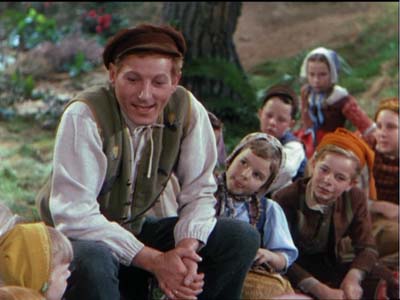
  • I love the expression of Danny Kaye's face in this photo. A copy of this photo appeared in Koenig's book. The biography explains how Kaye tried to create a persona for himself on stage which was so friendly and warm, to the point that the audience thought that they had really got to know who Danny Kaye was as an individual. Although Kaye seems to have been much more difficult and less personable in actuality, I like to think that the warm, kind person that he created on stage did exist within Kaye himself, or else he wouldn't have been able to portray it at all. In this photo Kaye appears with Victoria Paige Meyerink, a precocious four-year-old who appeared on Kaye's show several times (and received a lot of fan mail in the process!). I imagine that Meyerink has just said something amusing, and Kaye is looking out to the audience to connect with them in that amusement.

  • I was really surprised to learn that in the 1970s, Kaye took a break from show business to be a part-owner of the new Seattle Mariners team! Kaye owned several radio stations in Seattle too. After six losing seasons, though, Kaye sold his interest in the team (Koenig, p. 270). 
Since I started to read this book, I have also been interested in listening to a little bit of The Danny Kaye Show that aired on the radio in the 1940s. Episodes of this show are available at the My Old Radio and Radio Lovers sites. I don't think it's as fun to listen to Danny Kaye as watching him, but I still have a pretty good idea of the facial expressions and hand gestures that he might be using during the radio skits.

Tuesday, May 21, 2013

Debbie Reynolds on "What's My Line?"

J has always liked Rothko, but a few years ago he had a particularly intensive year when he read a lot about Rothko. That year even culminated in our trip to Houston to see the Rothko Chapel. I thought it would be fun to do a similar thing and follow the work of one person, but I'm interested in learning more about the actors and actresses from the "Golden Age" of Hollywood.

I haven't decided on who I want to study in depth, but it might be Debbie Reynolds. I just finished reading her new biography, Unsinkable: A Memoir. I also have been watching a few of her movies lately, like Two Weeks with Love (1950, with June Powell), Hit the Deck (1955, with Jane Powell and Russ Tamblyn), and The Pleasure of His Company (1961, with Fred Astaire).

Tonight I happened to come across a clip from when Reynolds was on the game show "What's My Line?" Her cute personality really comes through as she answers the questions posed by the blindfolded contestants. This episode aired in August 1954, the year before Reynolds got married to Eddie Fisher. They seem like such a happy and cute couple at the end of this clip. How sad that things didn't last. (Eddie Fisher left Reynolds and their two young children for Elizabeth Taylor. Reynolds and Fisher divorced in 1959.)


And, speaking of "What's My Line?", you should check out the episode with Dean Martin and Jerry Lewis and another episode with Salvador Dali.

Saturday, April 13, 2013

Jerry Lewis Photographs

J and I have a date tonight to see my favorite octogenarian. I'm very excited but also a little bit nervous to go. What if Jerry Lewis isn't funny as an old man?

To both feed my excitement and psychologically prepare for disappointment, this morning I've been looking at images of Jerry Lewis from when he was much younger. Even if he is old, I'm hoping that tonight I can see a hint of the funny facial expressions that I love:


Many photos found from HERE.

UPDATE:  Well, the performance was kind of a train wreck. He forgot the punch lines for more than half of his jokes, and he muddled several stories. His bandleader sat near Jerry at the piano with an intent look on his face; he was trying to follow the jokes and give Jerry prompts when needed. In between jokes, or sometimes during the middle of a joke, Jerry kept turning to the bandleader and either ask for a prompt or say, "Did I finish that one?"

Then Jerry held a Q & A with the audience, which ended up being thirty minutes of audience members speaking who didn't have questions to ask, but just said "I love you, Jerry," over and over. Some people wanted to stand up and voice their support of the Muscular Dystrophy Foundation. One lady wanted to say that she and her husbands were soul mates, because they both collected money for muscular dystrophy as children (?!?). Jerry kept saying that the purpose of this Q &A is to ask questions, but hardly anyone really did that. He was a little bit frustrated, along with most of the audience.

Ah well. It was a horrible show, and I felt rather confused and very tired as we walked out of the building. I think I silently exerted a lot of energy in my seat, because I kept hoping that the performance would improve. It didn't, but it was fun to at least see Jerry and applaud for him nonetheless. If anything, I was glad that he could hear my applause for all of the movies and television shows that have made me laugh over the years.

Tuesday, October 27, 2009

martin short as "jerry lewis"

The other night J commented about a SNL "Jeopardy!" skit where Martin Short plays Jerry Lewis. I'd never heard of this skit before. Since I like Jerry so much, I'm surprised that J never mentioned the skit earlier. My favorite part is around 4:04 in this clip, when "Alex Trebek" is trying to get "Jerry" to say the correct question to match the Jeopardy answer. The whole "cannon-ballin-mamin'" mumble is a pretty good JL impersonation.

Saturday, August 8, 2009

jerry lewis sings opera

If anyone ever says that it isn't physically-draining to sing (or to lip sync!), you can show them this clip. One of my favorite parts is at 1:33 when Jerry jumps back in the song with the phrase, "One kiss..." I also love the climax, when Jerry keeps doubling over from physical exertion. Hey, I totally can relate. Singing can really take it out of you.

Thanks for showing me this clip, C.

Thursday, March 12, 2009

jerry lewis, patrice munsel, and cassius clay

So, recently I bought this DVD that had an episode from the Jerry Lewis Show. This show was a short-lived variety series that aired from September-December 1963. After watching this show, I can see why it was canceled after a few months - it was awful! The show was aired live; sometimes it was so slow-paced that I could barely watch it. The only entertaining part was when Jerry sang "improvisation opera" with his guest Patrice Munsel. Their chit-chat is rather funny too, but the singing in this clip begins at about 2:58. It is even funnier if you understand what she's saying in Italian to Jerry ("Say something!" "What do you think?" "Speak!"). And Jerry just jabbers back in Italianate drivel:


Although this next clip wasn't exactly funny, it was interesting to watch. One of the other guests on this episode was Cassius Clay (Muhammad Ali). I knew that this boxer was cocky and self-confident, but it's astounding to hear him rattle on and on about how he is "so great." Start watching this clip at about 1:38 to get an idea:


Other than these two brief sections, this show was exceptionally lame. If my sister C wants this DVD for her Jerry Lewis shrine, she's more than welcome to have it.

Thursday, January 8, 2009

photography of sammy davis, jr.

One of my favorite Rat Pack singers is Sammy Davis, Jr. Not only is he a great singer and dancer, but he can do particularly good impersonations. (And no, we didn't name our son Samuel David after Sammy Davis!)

This is a really fun television clip that shows Davis' talent at impersonating singers and Hollywood stars. His impersonation of Jerry Lewis is pretty spot-on! I love his Jimmy Stewart impersonation too - it's almost disconcerting to hear Jimmy Stewart's voice coming out of someone else's mouth!


Last week my sister C let me borrow her copy of Photo by Sammy Davis, Jr. I didn't know this before, but Sammy Davis, Jr. was an avid photographer. This book by Burt Boyer is filled with photographs that Davis took at different parties, film sets, and public gatherings (e.g., one of Martin Luther King, Jr.'s speeches). There are candid photographs of several celebrities like Marilyn Monroe, Dean Martin, Jerry Lewis, Rock Hudson, Frank Sinatra, and Jacqueline Kennedy. Some of the photographs are quite artsy too, particularly ones of city life that were taken when Davis was on tour. The book also contains commentary by Boyer (a life-long friend of Davis) and also some excerpts from Davis' autobiographies (which Boyer and his wife co-authored with Davis). I think it's a really fun book - it's interesting to see the world of Sammy Davis, Jr. through his camera lens.

Friday, October 24, 2008

the whipping boy

Does anyone remember the children's book The Whipping Boy by Sid Fleischman? With Jemmy and Price Brat? I loved that book growing up. Even today, when I cook with too much garlic, I think of Hold-Your-Nose-Billy.

Maybe because I loved The Whipping Boy so much when I was little, I especially like these Dean Martin and Jerry Lewis clips from the Colgate Comedy Hour. This is the perfect premise for a Martin and Lewis sketch - Prince Dean has all of the fun while whipping boy Jerry gets beat up. I especially love Jerry's mock praises and insults. I cracked up when he said to the guards (with metallic hats), "A plague on thee, a plague on thee, thou father of a nail file!"

Thursday, July 24, 2008

Jerry Lewis Nostalgia: Colegate Comedy Hour with Rosemary Clooney

Many people who grew up with me know that Jerry Lewis films are one of my guilty/not-so-guilty pleasures. I'm not really a fan of slapstick comedy, but sometimes the timing of Jerry's movements are impeccable. I also agree that some of Jerry's antics are a bit prolonged in some scenes, but I love him just the same.

In high school, I would watch episodes of the Colgate Comedy Hour (Jerry Lewis and Dean Martin's television show from the 1950s) ad nauseam with my friends, particularly Katie and Heather. This video clip is of our favorite episode where Rosemary Clooney was a guest (though I didn't include any clips with Clooney). I especially love this episode because there is so much improv between Martin and Lewis. Heather and I must have been influenced by all of this improv and banter - we took improv to the utmost level during our district drama competition, where we improvised our whole scene because both of us had been too lazy to memorize the script. The hilarious thing is that we actually won the district competition and were sent to the state competition after that - which we promptly lost because we still hadn't memorized our lines.

Things I love about this episode: When Jerry gets after the audience for laughing at a "non-funny" joke (27:30); when he calls his coat a "puzzle" because he is fumbling with it on the set; the look on his face while saying "Isn't that a stunning model?" I also love that naive Jerry helps the burglar load wedding presents into his sack and the burglar makes a clean get-away.

In order to make amends, Jerry decides to clean up the mess in the room. I like when he lifts up his hands in fake surprise while saying the word "cleaner" (35:04). My high school friends and I would sometimes do this movement to feign astonishment, and I still find myself wanting to do it at times - though I generally refrain myself since no one would get the joke. I also love the expression in Jerry's face while the butler is giving his line.

I also love the musical number is at the end of the episode. I especially love how Dean starts to laugh when Jerry asks him if he wants an "introduction" (44:46). And I can't help but crack up every time Jerry falls down when the music booms especially loud (46:00). The timing is so great.

This being said, I also have to say that I love Dean Martin too. Jerry wouldn't be as funny without Dean acting as his "straight man." Sometimes I think Dean goes unappreciated when people talk about the "Martin and Lewis" team. He really is a great comedian too, not to mention a fabulous singer.