
We arrived in Bergama in the late afternoon, and first decided to explore the city for a bit.

We ended up spending over an hour in this shop, visiting with the shop owner and looking at the merchandise. The shop owner was crippled in some way, so he had two assistants (including the girl on the right of this photo).
The next morning, we took a gondola to the top of the acropolis of ancient Pergamon. Zillah isn't a fan of heights, but I'm glad that she semi-smiled for this picture.


We noticed the Kestel Dam located underneath the acropolis. My friends' guide books discussed how this dam covered up some ancient ruins. I did some research on this dam (and another Turkish dam which covered up some ruins) after I got home.

Ruins from the Temple of Trajan

The stairs for the theater were really steep! We were alone down here; none of the other tourists wanted to brave the steep stairs.


The ancient site for the Altar of Zeus! Be still my heart!

Here's a reconstruction drawing for where the Altar of Zeus was located in relation to other buildings on the acropolis.
I took a small video, so I could show students where the altar is located in relation to the edge of the acropolis

Phin, Ixoj, and Zillah walking through the neighborhoods of Bergama, after we left the acropolis
After the acropolis, we visited the Red Basilica (also known as the "Serapeion" or "The Temple of the Egyptian Gods"). This temple was probably founded in the 2nd century CE (during the rule of Hadrian). It is especially interesting because the roof of the galleries were supported by caryatids (female figures that serve as columns) that were decorated in the Egyptian style. It is thought that this building was actually made for Egyptian gods. My grammatically-incorrect Pergamon guide book asserts, "The temple must have been devoted to Gods Sespis with Iris and Harpok rates [sic?] worshiped somewhere in [the] Roman Empire. [During] the Byzantine period, a church was founded [here]."1

The Red Basilica (from the back)

You can see the remains of an Egyptian headress on this statue (which also seems to be wearing classical clothing). This is a really interesting combination of both Egyptian and Greco-Roman styles.

The Red Basilica is quite well-preserved
After the Red Basilica, we walked over to the local archaeological museum. All of the places that we wanted to see in Bergama were fairly close together, so it wasn't to hard to walk places. It was, however, pretty hot. So we had to refresh ourselves with some Magnum bars before going into the museum.

Even though I didn't get to see the actual Altar of Zeus, I did like looking at the scale model. It was fun to see where bits of the frieze have been discovered, not only in the front of the structure, but the back as well

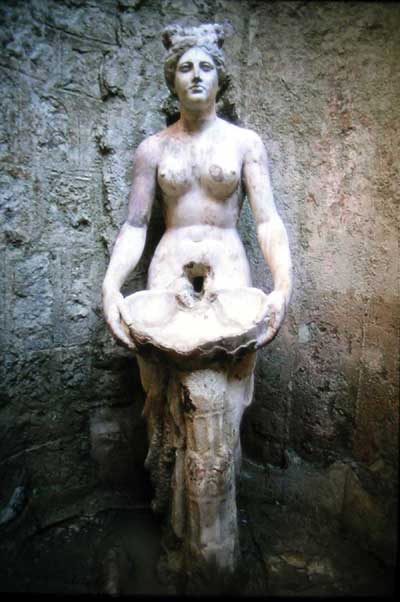
The museum was full of a lot of various things that had been excavated in the area, including this statue of a hermaphrodite. It reminds me a little bit of the Allianoi Nymph.

This "Medusa Mosaic" was excavated in the Lower City of Pergamon. Wouldn't you like something like this on your floor?
After all of those adventures, it was time to slowly head back home. We sat outside the archaeological museum for a bit, ate apricots from a tree in the museum's garden (which were handed to us by a security guard), and then we headed back to our hostel to get our things. We took a bus to Izmir, then flew from Izmir to Istanbul. We all tried to sleep in the airport for a few hours, before heading back.

Note my totally-awesome sleeping mask (I'm in the background, covering myself with a green sweater)
What a trip! I'm so glad that I was able to go on such an adventure with such dear friends. Who knows when we'll do a mega-trip like this again...maybe when we all turn forty?
1 Tevhit Kekeç, Pergamon (English), (Istanbul: Hitit Color, n.d.), 76.


 Posts
Posts


2 comments:
Monica, your pictures are amazing! I love seeing and hearing about all of the places you were able to visit. What an incredible experience! I miss you!
It has been such fun to read your posts and enjoy your photos as an armchair traveler. Thanks for taking the tie to write it all out.
I also love your post about the Hermitage Peacock Clock on your Art History blog.
I hope you get to go on many more fantastic trips.
Post a Comment