I realize that this post won't be terribly interesting to many people, but I want to create a list of random facts about Brazil that can readily be accessible to me. I am teaching a course on Brazilian art that starts next week; I think students might appreciate learning a few random facts about this country. I feel like a lot of people don't know about Brazilian culture and history, apart from things like soccer and Carnival. I certainly didn't know much about Brazil before I lived there for a year and a half.
 Here are some of the facts that I compiled, many of them drawn from this documentary (so I suppose there is a chance that a few of these facts are outdated since the documentary came out in 2006, but I doubt it).
- Brazil is the 5th largest country in the world.
- Brazil borders all of the other countries in South America except Chile and Ecuador.
- The distance of Brazil (from one side to the other) is greater than the distance between Brazil and Africa.
- Much of the land in Brazil is inaccessible. About 1/3 of Brazil is covered in dense jungle.
- When the Portuguese arrived in Brazil in 1500, there were more than 6 million indigenous people and 2,000 distinct tribes. Today, there are only 350,000 indigenous people.
- There still are a few elusive indigenous tribes who have not made contact with the outside world.
- The city of Manaus was founded in 1669 to protect slave traders along the river.
- For a brief time during the "rubber boom," Manaus was the richest city in the world. Residents allegedly had their clothes sent to Europe to be laundered. An opera house was constructed in Manaus during this economic heyday.
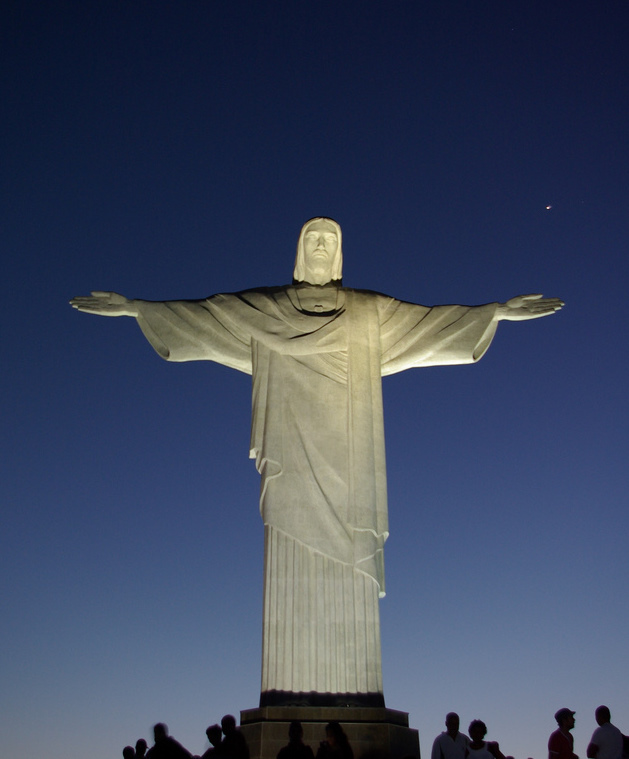
- The "Christ the Redeemer" (Cristo Redentor) statue in Rio de Janeiro is 125' tall. The arm span of the sculpture is 90'.
- Brazil is the world's capital for plastic surgery. A quarter of a million plastic surgeries are performed each year. One year, during Carnival, it is reported that in 2000 so many women wanted breast implants that the country briefly ran out of a certain type of silicone.
- Pelourinho (the historic center of the city Salvador, Bahia) was built around the whipping posts where slaves were punished.
- Bahia is the most African state in Brazil. Blacks comprise 80% of the people in Bahia.
- Brazil has the 2nd largest African population in the world (second only to Nigeria).
- About 3.5 million slaves (other sources say 4 million slaves) were brought to Brazil during the 16th and 17th centuries.
- 40% of all of the slaves that crossed the Atlantic went to Brazil. This means that Brazil received about seven times more slaves than the United States of America.
- Capoeira was not legalized until the 1930s. (I think I knew this fact when I wrote my thesis, but I thought I'd re-remember it here.)
- Brazil is the largest Catholic nation on earth, with 145 million believers.
- The interior of the church Nossa Senhora do Pilar (Ouro Preto) is decorated with almost 1,000 pounds of gold.
- Rio de Janeiro was the capital of Brazil from 1763 to 1960.
- Brasilia was built in the late 1950s. Lúcio Costa won the contest to become the urban planner of the city. Oscar Niemeyer was the chief architect for many of the public buildings.
- Brasilia became the capital of Brazil (instead of Rio de Janeiro) in 1960. The idea of having a centrally-located capital had been proposed at the end of the 19th century, but the proposal was not realized for several decades.


 Posts
Posts