I haven't been in the mood to write about my trip to Turkey lately, but I'm determined write at least something. I think that the task just seems to daunting, because this trip was so momentous and activity-filled. Plus, my friend ixoj recapped our trip really well (see her posts: Turkey Part 1, Turkey Part 2, Turkey Part 3, and Random Turkey Thoughts). I feel like so many things have already been recorded, but I'm forcing myself to write. I know that there are other things that I want to remember. I thought I'd jot down a few bullet points, because that somehow seems more manageable:
- When we arrived in Istanbul at 2:00 am, we had a taxi driver take us to our hostel. The windows were rolled down. I distinctly remember warm, heavy, purfumed air come wafting through the taxi windows. While driving, I remembered a quote about an Delacroix painting which was described as being "redolent of the exotic, perfumed, and drugged harem atmosphere."1 Whenever I caught a waft of some perfumed, spiced air during my trip in Istanbul, I couldn't help but think of this quote. The warm, heavy atmosphere in Turkey reminded me very much of Orientalist descriptions that I have read about harems.

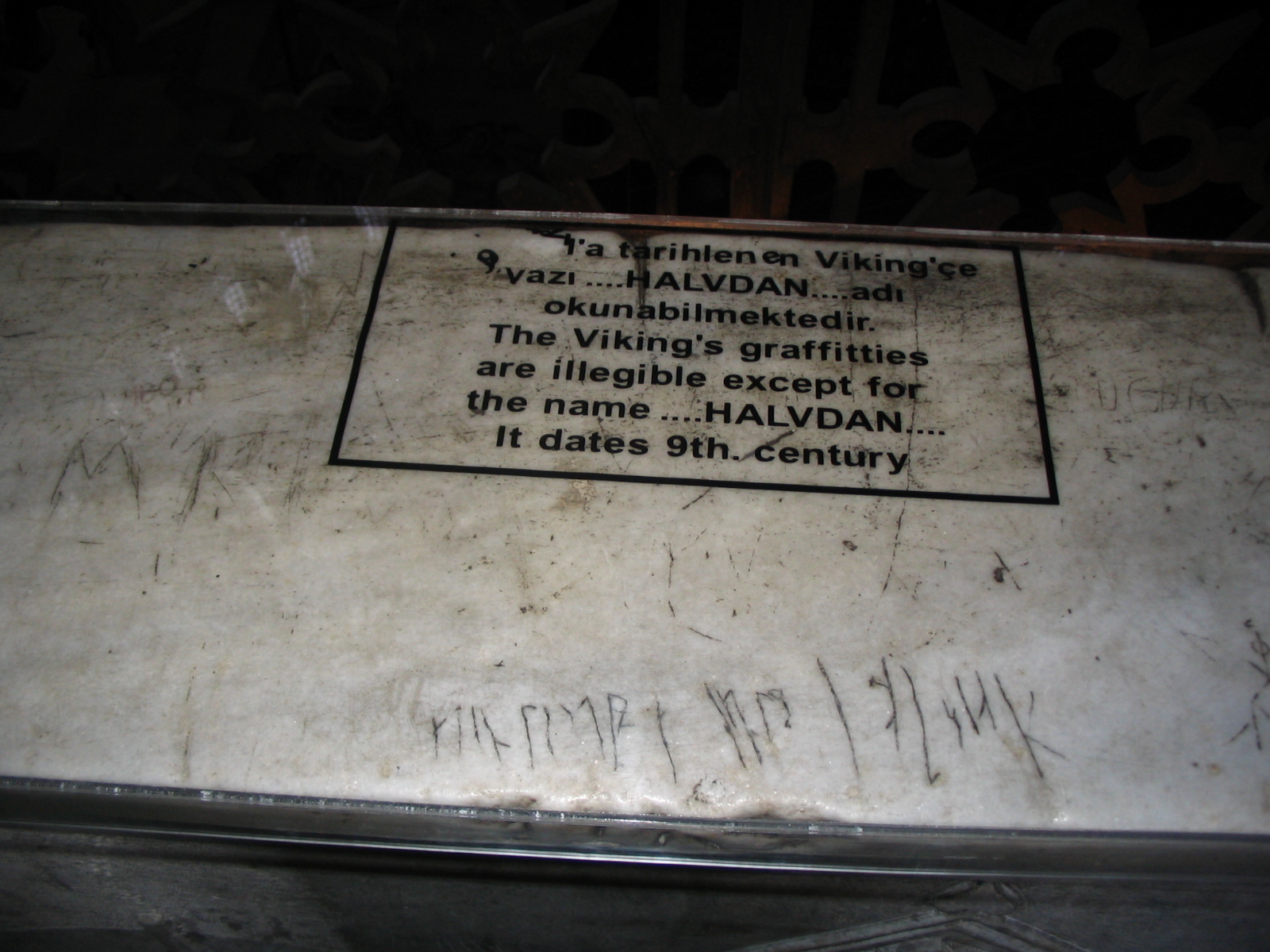
- I loved seeing Hagia Sophia and the Chora Church. Those were dreams come true! I loved seeing the Anastasis painting at the Chora Church. And I loved Hagia Sophia. The space inside the building was so majestic and awe-inspiring. And I really liked seeing the "golden chain" of light that surrounded the base of the Hagia Sophia dome. It was especially interesting to be in this church and see both the Muslim and Christian influence (and also how Muslims tried to cover up Christian imagery with either plaster or modifying the relief carvings of the cross). My one disappointment is that I didn't see the Viking graffiti in Hagia Sophia. I looked everywhere, but couldn't find it! Next time I'll have to actually pay for a tour guide.

The Obelisk of Theodosius, erected 390 CE

The base of the Obelisk of Theodosius, erected 390 CE. It was interesting to see this Roman base supporting an obelisk with Egyptian hieroglyphs.

One of the Medusa heads in the Basilica Cistern. These two heads serve as the base for some columns and seem to have been intentionally placed upside down (or on their side). I'm sure they were just placed that way for functional purposes. These sculptures were used to support columns, and the heads were probably inverted so that they would be the right height and/or size for that load-bearing function. No one in the Byzantine period would have imagined that tourists would be crawling through their underground cistern in the 21st century!
- It was really neat to see all of the Roman and Byzantine influence in the city, too. I really liked seeing the Eyptian obelisk in the Hippodrome, as well as the upside-down Medusa heads inside the Basilica Cistern.
- I'm glad that my friends convinced me to go on a Bosphorous Cruise. The palaces along the shore were really neat to see. Plus, the water in the Bosphorous was so blue! It was lovely.
- I don't really like shopping, but I did enjoy seeing all of the eclectic goods for sale in the Grand Bazaar. One of the neatest things was a 19th century iron press which was used to imprint images of the crucifixion onto bread at Eastertime.
- Istanbul was extremely HOT and humid. We were sweaty all of the time, and my hair was a poofy frizz-ball.
- Our hostel was located next to a big avenue that was sectioned off for shopping. It was fun to pass all of the shops each night, as we made our way back to our hostel. The only downside of our location was that our hostel was located near a night club. It was sometimes hard to sleep with club music blaring.

Galata Tower is claimed to have been built during the 6th century CE.
- I will also remember sitting at the base of Galata Tower and eating Magnum bars, in honor of Rachsticle's birthday. If only we had known that she was about to break her ankle on the other side of the world!


These lions (a symbol of the fertility goddess Ishtar) lined the processional way of the Ishtar Gate. It was neat to see these bricks up close, because you could tell that the animals were in relief (they project out from the flat surface of background).
- The Istanbul Archaeological Museum was really cool. I spent a long time wandering through the galleries on my own. I liked seeing the Alexander Sarcophagus and the few examples from the Ishtar Gate. (I wasn't aware that part of the gate and processional way were in Istanbul! I thought everything was at the Pergamon Museum in Berlin, but I was wrong.)

The courtyard of the Süleymaniye II mosque

Detail of the Western painting within the dome of the Suleymaniye Mosque.
- I loved the Suleymaniye Mosque! There were domes all over the place: lining the roof of the courtyard and the main area of the mosque, too. The atmosphere was so calm and pleasant in this space. I also liked the interior decoration. The painting inside the main dome looked quite Western to me (see above). The whole feel of the mosque was really different from the crowded Blue Mosque (which had a lot of irreverent and disrespectful tourists).

The New Mosque. We never went inside of here, but we passed this mosque every day as we would walk into the Old City. One evening we passed by right as the call to prayer took place.
- It was really neat to hear the call to prayer at multiple times during the day. You could tell that some of the muezzins at the larger mosques had more experience (and were a little bit more formulaic and proper in their call to prayer). I wonder if this more formulaic approach is because the muezzins in Istanbul were underwent vocal training a few years ago. When we went out to the country, I noticed that the muezzins were a little bit more creative in their approach to call to prayer. The muezzin in Patara (a small beach town) seemed to like to improvise, but I didn't get such a relaxed feel from the muezzins in Istanbul.


 Posts
Posts