Tuesday, September 20, 2011

here we go...

I did an extra-deep clean of the house this morning. I went grocery shopping today with Sam. We stopped by the post office to mail a package. Sam and I returned library books this afternoon. The laundry is done. I've tried to think of all of the errands and household chores that need to happen, in an effort to make the next few days a little easier. Come tomorrow morning, I will be responsible for 122 art history students until mid-December. (I felt the stress mounting as I typed that last sentence!)

For the past two weeks I've been reflecting on this past summer. I had so many plans for things that I wanted to do - one of the main ones being that I wanted to be completely prepared for my upcoming Brazilian art class. And, well, I'm not nearly as prepared as I had hoped to be. I'm wrestling with the disappointment of not meeting my personal goal, and also trying to battle the urge to feel stressed or anxious about this class. I know it will be fun and interesting to teach, but I'm nervous to teach a full course on such an obscure topic. I feel like I need to look at five, six, or seven different sources to compile the information I need for each lecture. And finding/scanning/preparing about 40-60 images for each PowerPoint presentation is going to take lots of time. Argh! There is so much to do!

Where did the summer go? What did I do with my time? Why didn't I get more done for this class? I feel like I was really busy - and I was - but I ended up doing things that I didn't anticipate:
  • I taught an intensive six week course online (just a basic introduction to art)
  • I wrote a proposal (along with a colleague in Mississippi) for a 2013 CAA conference panel
  • I wrote an abstract for an upcoming Women's Studies conference this November
  • We went to Disneyland with my family
  • I recorded 13 lectures (each one about 2.5 hours long) for the online class that I'll be teaching this Fall
  • I've blogged (10 posts on this site and 23 art history posts)
  • I've read at least twenty art history articles and books
  • I've started about six lectures on Brazilian art (with a smattering of scanned images)
  • I've scanned about 20 pictures on Brazilian art
  • I've prepared some PDF files on Brazilian art for students to read
  • I moved my art history blog to a new site (with a lot of help from J)
  • I spent every day with Sammy Sam.
And, there you have it. That's what I've done this summer. And looking back at this list, I realize that I'm really glad about the things that I did - even though I didn't accomplish everything that I had hoped to do.

Even though I'm not 100% prepared for this Brazilian class, I do feel ready to get in the classroom and start teaching at least something. I've thought and stewed about this class for so long - I'd like to stop thinking and start doing.

Saturday, September 17, 2011

maryhill museum of art

A few weeks ago we went to visit the Maryhill Museum of Art near Goldendale, Washington. This museum has quite an interesting history. It is located in a mansion that belonged to Samuel Hill in the mid-20th century. The museum was created when Hill collaborated with an eclectic group of three friends: Loïe Fuller, a famous modern dancer in Paris; Queen Marie of Romania, the granddaughter of Queen Victoria; and Alma Bretteville Spreckels, wife of San Francisco sugar magnate Adolf Spreckels.

This summer I've been thinking about museums that were set up by private collectors. When someone told me that the Maryhill was a "collection museum" located in Washington State, we decided to take a day trip and check it out.

View of the museum from the highway. The grounds sit like a lush oasis in the middle of brown, dry Washington/Oregon hills.

You can really see the contrast of the grounds and landscape in this image. There were gigantic, massive white windmills that lined this whole area. The highway went directly underneath some of them; they were fun to see up-close.

This isn't a spectacular view with all of the fence and construction materials (the museum is currently building an extension), but I wanted to show a view of the Columbia River from the museum terrace.

The sculpture garden on the museum grounds was really fantastic. We all loved this sculpture by Matt Cartwright, Malabar Bombax (2009). I especially liked what Cartwright wrote for the text label: "This flower of the Red Silk Cotton tree - with its blooming shape - is a colorful, luscious inspiration to me. . . And perhaps this sculpture can evoke the viewer's inner insect as they buzz from sculpture to sculpture within the Maryhill Sculpture Garden."


Upon entering the museum, the viewer is confronted with a whole gallery full of imperial Romanian art. It's such a bizarre thing to encounter in middle-of-nowhere-Washington! The museum also boasts an extensive Rodin collection among other things. Granted, the Rodin pieces are mostly plaster casts and studies, but it still is fun to see.

One of the most unusual, unexpected features of Maryhill Museum is the full-scale replica of Stonehenge, which is just located about 4 miles south of the museum grounds. When Samuel Hill visited Stonehenge in England, he was told that the Neolithic monument was used for human sacrifices to pagan gods. (Side note: that theory is no longer accepted by most scholars.) After WWI, Hill returned to the US and built a war memorial to commemorate the soldiers who sacrificed their own lives. Granted, Hill's concrete memorial is quite different from the megaliths of in England, but it is still an impressive structure. It's also cool to stand here and get an actual sense of Stonehenge's original scale (since today so many stones are missing from the English monument).

A view of the Columbia River from the Stonehenge replica. What a juxtaposition!

If any Washingtonians are interested in checking out the Maryhill Museum of Art, let me know! I'd love to go again.

Monday, September 12, 2011

random Brazil facts

I realize that this post won't be terribly interesting to many people, but I want to create a list of random facts about Brazil that can readily be accessible to me. I am teaching a course on Brazilian art that starts next week; I think students might appreciate learning a few random facts about this country. I feel like a lot of people don't know about Brazilian culture and history, apart from things like soccer and Carnival. I certainly didn't know much about Brazil before I lived there for a year and a half.

Here are some of the facts that I compiled, many of them drawn from this documentary (so I suppose there is a chance that a few of these facts are outdated since the documentary came out in 2006, but I doubt it).
  • Brazil is the 5th largest country in the world.
  • Brazil borders all of the other countries in South America except Chile and Ecuador.
  • The distance of Brazil (from one side to the other) is greater than the distance between Brazil and Africa.
  • Much of the land in Brazil is inaccessible. About 1/3 of Brazil is covered in dense jungle.
  • When the Portuguese arrived in Brazil in 1500, there were more than 6 million indigenous people and 2,000 distinct tribes. Today, there are only 350,000 indigenous people.
  • There still are a few elusive indigenous tribes who have not made contact with the outside world.
  • The city of Manaus was founded in 1669 to protect slave traders along the river.
  • For a brief time during the "rubber boom," Manaus was the richest city in the world. Residents allegedly had their clothes sent to Europe to be laundered. An opera house was constructed in Manaus during this economic heyday.
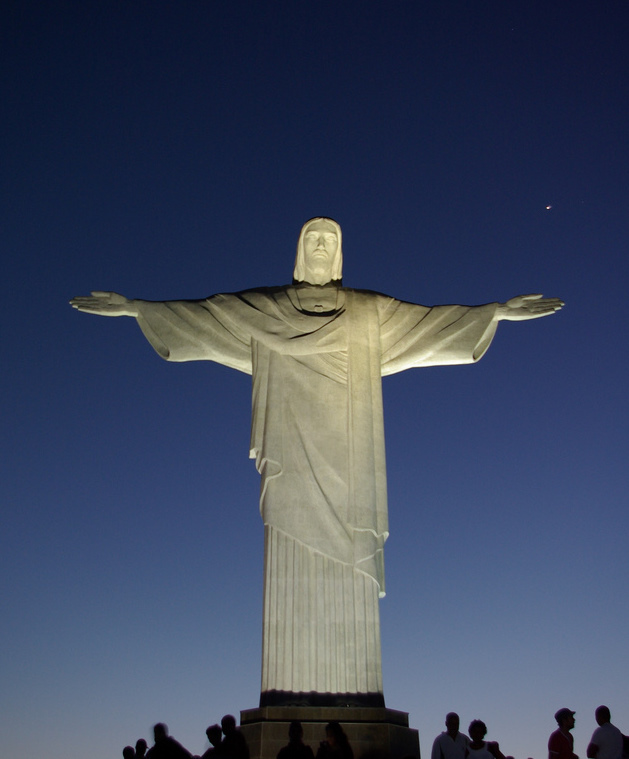
  • The "Christ the Redeemer" (Cristo Redentor) statue in Rio de Janeiro is 125' tall. The arm span of the sculpture is 90'.
  • Brazil is the world's capital for plastic surgery. A quarter of a million plastic surgeries are performed each year. One year, during Carnival, it is reported that in 2000 so many women wanted breast implants that the country briefly ran out of a certain type of silicone.
  • Pelourinho (the historic center of the city Salvador, Bahia) was built around the whipping posts where slaves were punished.
  • Bahia is the most African state in Brazil. Blacks comprise 80% of the people in Bahia.
  • Brazil has the 2nd largest African population in the world (second only to Nigeria).
  • About 3.5 million slaves (other sources say 4 million slaves) were brought to Brazil during the 16th and 17th centuries.
  • 40% of all of the slaves that crossed the Atlantic went to Brazil. This means that Brazil received about seven times more slaves than the United States of America.
  • Capoeira was not legalized until the 1930s. (I think I knew this fact when I wrote my thesis, but I thought I'd re-remember it here.)
  • Brazil is the largest Catholic nation on earth, with 145 million believers.
  • The interior of the church Nossa Senhora do Pilar (Ouro Preto) is decorated with almost 1,000 pounds of gold.
  • Rio de Janeiro was the capital of Brazil from 1763 to 1960.
  • Brasilia was built in the late 1950s. Lúcio Costa won the contest to become the urban planner of the city. Oscar Niemeyer was the chief architect for many of the public buildings.
  • Brasilia became the capital of Brazil (instead of Rio de Janeiro) in 1960. The idea of having a centrally-located capital had been proposed at the end of the 19th century, but the proposal was not realized for several decades.

Friday, September 2, 2011

emma watson and modesty

Last week, a friend and I were discussing the concept of modesty. Who really has the authority to determine whether something is modest or not? Is it the person who wears the clothing? Or is it the viewer of the person who is wearing the clothing in question? Or perhaps both? As we talked about this idea, I suggested that the person who wears clothing should have the authority to determine whether his or her clothing is modest. If someone is wearing something with the intent of being sexy or suggestive, then such clothing should not be considered modest.

I began thinking about this conversation today, when I noticed someone post this image of Emma Watson on Facebook (see above), which includes an excerpt from this quote by Watson: "What's sexy about saying, 'I'm here with my boobs and a short skirt, have a look at everything I've got?' My idea of sexy is that less is more. The less you reveal the more people can wonder."

I've seen this image and quote before - it seems to get circulated intermittently in LDS circles. I have to admit, I think that such circulation is a little ironic. Yes, it makes sense that LDS people would want to promote Watson's idea of modesty covering up your body. But if you read the quote, Watson is still promoting sexiness and self-objectification. I don't think this constitutes modesty from an LDS perspective. In theory, Mormons promote modesty as a way to avoid provoking sexual (lustful) thoughts in others. (But perhaps the popularity of this image and quote among Mormons suggests that they actually want to be sexy, too?)

So, yes, Emma Watson does want to cover up her body. But she still wants others to think about her body. (It is actually this self-objectification that bothers me more than anything, mostly from a feminist standpoint. Argh!)

Thoughts, anyone?

house pictures

Per Phin's request, I'm finally posting a few pictures of our new-ish house. We really like this house, but that doesn't stop J from obsessively following the housing market. He wants to make sure that there isn't a better house (or a house that has the potential to be better) that is located in the area. Personally, I think we have it really good in our current place; I secretly hope that we won't end up moving again.

Living Room
My office.
It seems like I rush to this place whenever I have a spare moment.
There's so much work to be done for the upcoming school quarter!

Sunday, August 7, 2011

dahlia explosion

Compare, if you will, the difference between these two photos of our yard. The first photo was taken at the beginning of June (used in this earlier post), and the second was taken today.

June 2011

August 2011

Notice any major difference? (Okay, I know that our lawn isn't as green as it used to be. And you may notice that currently our bushes are nicely sculpted. Yesterday I woke up from a nap, only to find that J had turned into Edward Scissorhands. He went around our yard for a few hours, trimming everything in sight. The hedges and bushes look great. But those differences between these photos aren't what I have in mind.)

If you look in the back of the photos, in the garden bed by our trellis and rosebush, you'll notice a teeny-tiny green bush on the right side (next to the stepping stones). That bush has exploded over the past few months, recently revealing that it is a dahlia bush:

This plant is huge and it has caught us completely by surprise. It has overpowered some of my little zinnias, and now is starting to infringe upon our stepping-stone rocks. I'm curious to see how big this bush gets by the end of the summer. If dahlias weren't such a gorgeous flower, I would have thought that the owners planted the dahlia starter bush as a practical joke on their unsuspecting tenants.

Don't be surprised if our front door is completely covered in the next few weeks!

On a side note, it's been fun to compare our current flower beds to the picture that I took at the beginning of June. We have some really happy flowers in our yard right now:


Tuesday, August 2, 2011

"Smithsonian" magazine giveaway

Some of you may have noticed that I am having a little giveaway on my art history blog. If any of you are interested in getting a free 12-month subscription to Smithsonian magazine, feel free to enter the giveaway drawing! I will select two winners next Tuesday, August 9th.

By the way, this giveaway is to celebrate passing the "the 300th post mark" on my art history blog. And I just noticed that I this is my 307th post here at Scattered Apples. That means I have written over 600 blog posts since I started to blog in 2007. Oh my! Maybe I need to get out more...