

Yesterday Kelly took me to see some of the famous buildings and monuments in Brasilia. We drove into the city on the JK Bridge (shown above) and went to the Praça dos Tres Poderes to see the government buildings. We drove past the Congresso Nacional (the double towers), Palácio do Planalto,

We first went inside the Metropolitan Cathedral (Catedral Metropolitana de Nossa Senhora da Aparecida). I've taught about this structure several times, so it was really special for me to be in the space. Here were a couple of my observations for the cathedral (as well as what I have learned from the online guide):
- I've never noticed the carillon in images of the cathedral. This was designed by Niemeyer and dedicated in 1977. The bells were a gift of the Spanish government. Three of the bells represent the boats of Christopher Columbus and the other bell represents Nossa Senhora do Pilar (who is heavily venerated in Spain).
- You really get a sense that you are underground when you are in the cathedral space. The wall curves up to about 6' tall, and then the windows appear just above (which would be ground level outside)
- The cathedral was very warm and kind of miserable to be inside, with all of the light beating down through the windows. This structure totally fits with modernism: it is glorious to look at, but completely not user-friendly and comfortable.
- There is supposed to be a reflecting pool that surrounds the structure! It was completely drained, like most of the reflecting pools and fountains that I've seen on my trip.


I didn't realize that there was a baptistery that was created later in the cathedral. The elevated ceiling can be seen popping out from above the ground line, like a flying saucer, just next to the cathedral entrance.


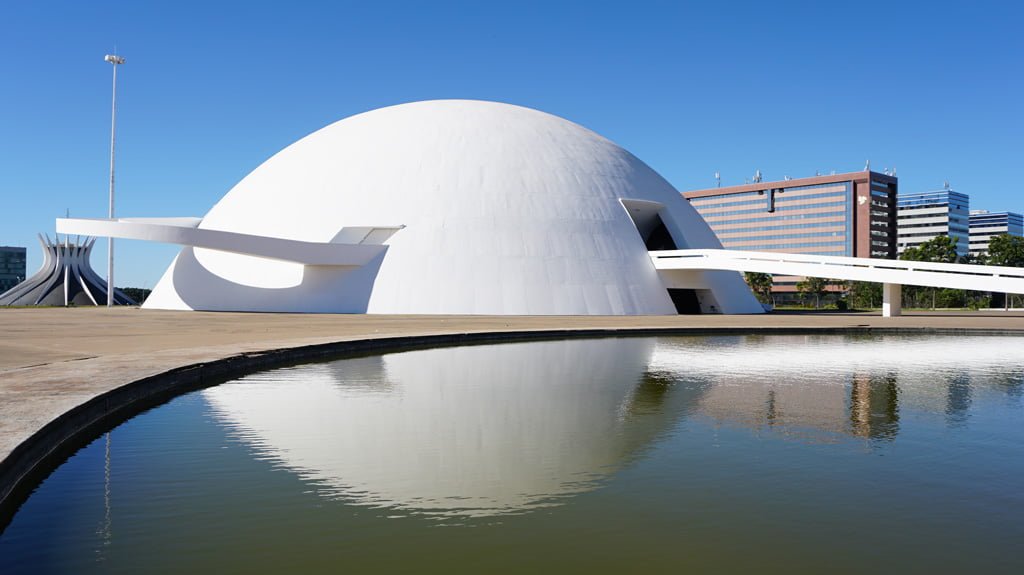
After the cathedral we went to the Museo Nacional nearby (another Niemeyer building). The art wasn't that interesting inside, so we headed over to the Espaço Lúcio Costa, an underground plaza, to see a display of the airplane-shape floorvplan of the city. Then we walked across the above-ground plaza to see the Panteão da Patria (Pantheon of the Homeland). This building is dedicated to peace, and the structure is supposed to look like the wings of a dove.

Panteão da Patria


The inside of the building has a memorial to Tancredo Neves, who was supposed to be sworn in as the first democratically-elected president but was too ill to be sworn in (his vice-president assumed power in his stead) and then died shortly thereafter. The white monument above (with the eternal flame) is dedicated to Tancredo Neves's memory. Inside the Panteão da Patria is also a series of panels that honor the Inconfidência Mineira by João Camara Filho. They are placed opposite a stained glass window by Marianne Peretti; the window is supposed to evoke either the shape of Brazil or a tree.


Os Inconfidentes gathered around to conspire!

Death of Tiradentes
Afterward we looked at the Os Candangos sculptures. Kelly pointed out that the nickname "candangos" originally was a pejorative term meaning "ordinário" or "ruim," since it was used to denote immigrants of African descent who came to Brasilia to help build the capital in a matter of years. The sculpture was built in 1959 by Bruno Giorgi in honor of these workers who helped to build the city. Bruno Giorgi was himself an immigrant (he was extradited to Brazil in the 1930s due to his involvement with the anti-fascist movement).


Os Candangos with the Palacio do Planalto in the background

The sun is bright and hot in Brazil!


 Posts
Posts




No comments:
Post a Comment