Thursday, August 2, 2012

Ancient Pergamon (Bergama)!

On our final leg of the trip, we headed to Bergama (the modern city where ancient Pergamon is located). I had specifically requested that we make a trip up here, since I wanted to see the place where the Altar of Zeus originally was located. (The Altar of Zeus was relocated to Berlin; the transfer of the altar actually had an effect on the scholarship of Baroque art.)

 We arrived in Bergama in the late afternoon, and first decided to explore the city for a bit.

We ended up spending over an hour in this shop, visiting with the shop owner and looking at the merchandise. The shop owner was crippled in some way, so he had two assistants (including the girl on the right of this photo).

The next morning, we took a gondola to the top of the acropolis of ancient Pergamon. Zillah isn't a fan of heights, but I'm glad that she semi-smiled for this picture.


We noticed the Kestel Dam located underneath the acropolis. My friends' guide books discussed how this dam covered up some ancient ruins. I did some research on this dam (and another Turkish dam which covered up some ruins) after I got home.

Ruins from the Temple of Trajan

The stairs for the theater were really steep! We were alone down here; none of the other tourists wanted to brave the steep stairs.


 The ancient site for the Altar of Zeus! Be still my heart!

Here's a reconstruction drawing for where the Altar of Zeus was located in relation to other buildings on the acropolis.

 I took a small video, so I could show students where the altar is located in relation to the edge of the acropolis

  
Phin, Ixoj, and Zillah walking through the neighborhoods of Bergama, after we left the acropolis 

After the acropolis, we visited the Red Basilica (also known as the "Serapeion" or "The Temple of the Egyptian Gods"). This temple was probably founded in the 2nd century CE (during the rule of Hadrian). It is especially interesting because the roof of the galleries were supported by caryatids (female figures that serve as columns) that were decorated in the Egyptian style. It is thought that this building was actually made for Egyptian gods. My grammatically-incorrect Pergamon guide book asserts, "The temple must have been devoted to Gods Sespis with Iris and Harpok rates [sic?] worshiped somewhere in [the] Roman Empire. [During] the Byzantine period, a church was founded [here]."1

The Red Basilica (from the back)

You can see the remains of an Egyptian headress on this statue (which also seems to be wearing classical clothing). This is a really interesting combination of both Egyptian and Greco-Roman styles.

The Red Basilica is quite well-preserved

After the Red Basilica, we walked over to the local archaeological museum. All of the places that we wanted to see in Bergama were fairly close together, so it wasn't to hard to walk places. It was, however, pretty hot. So we had to refresh ourselves with some Magnum bars before going into the museum.

 Even though I didn't get to see the actual Altar of Zeus, I did like looking at the scale model. It was fun to see where bits of the frieze have been discovered, not only in the front of the structure, but the back as well

 
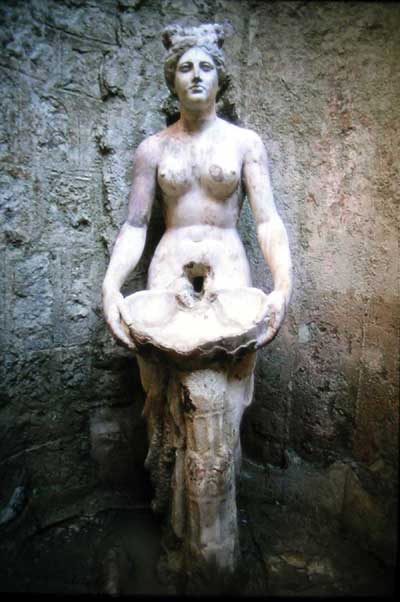
The museum was full of a lot of various things that had been excavated in the area, including this statue of a hermaphrodite. It reminds me a little bit of the Allianoi Nymph.

 This "Medusa Mosaic" was excavated in the Lower City of Pergamon. Wouldn't you like something like this on your floor?

After all of those adventures, it was time to slowly head back home. We sat outside the archaeological museum for a bit, ate apricots from a tree in the museum's garden (which were handed to us by a security guard), and then we headed back to our hostel to get our things. We took a bus to Izmir, then flew from Izmir to Istanbul. We all tried to sleep in the airport for a few hours, before heading back.

Note my totally-awesome sleeping mask (I'm in the background, covering myself with a green sweater)

What a trip! I'm so glad that I was able to go on such an adventure with such dear friends. Who knows when we'll do a mega-trip like this again...maybe when we all turn forty?

1 Tevhit Kekeç, Pergamon (English), (Istanbul: Hitit Color, n.d.), 76.

Ephesus!

After leaving Patara Beach, my friends and I rode a bus for a few hours until we got to Selçuk (the modern city just outside the ancient city of Ephesus). We went for a walk that evening, and then went shopping for a few hours.

We went and looked around the courtyard of the Mosque of Isa Bey

Phin next to the field where the ancient Temple of Artemis used to be located. The Temple of Artemis was considered to be one of the Seven Wonders of the World by ancient writers. You can see the remaining column in the background. (After I got home, I wrote a little bit about the Temple of Artemis on my art history blog.)

Turkish rugs!


The next morning, we woke up early and went to Ephesus as soon as the grounds opened. The crowds were pretty light, at least for Ephesus.


 View of Ephesus with the Library of Celcus in the background. The library façade is the best-preserved architecture on the site.

 The British tourists who took this picture didn't make sure that the ruins were visible in the background. Oh well!

Detail of the coffered ceiling inside the Library of Celcus

The Temple of Hadrian


As we walked around the ruins, I was struck by all of the brightly-colored poppies that were growing among the ruins. I couldn't help but think about this new vibrant form of life was flourishing among the rubble of the past. It was a nice reminder about how life continues.

After seeing Ephesus, we went and visited the Basilica of Saint John. This church is the burial place of John the Evangelist. According to the historian Eusebios, John and Mary returned to Ephesus after being banished from Jerusalem between 37 and 42 CE. The site marks the place where St. John is buried. Although an Early Christian church was constructed in the 5th century at this site, the ruins that we saw there from a middle 6th century monumental basilica (which was constructed by Justinian). Some of the materials for the basilica were collected from the nearby ruins of the Temple of Artemis, which was largely demolished by that the time. So, in essence, we got to see some of the Temple of Artemis, albeit in a completely different form!


After seeing the basilica, my friends wanted to do a bit more shopping. I opted to go and visit the Ephesus Archaeological Museum instead, and I'm really really glad that I did. This museum was one of the highlights of my trip to Turkey. The museum houses two different ancient statues of Artemis as a fertility goddess. The statues have their own room in the museum: they are placed on two different walls, facing each other, with a model of the ancient Temple of Artemis in-between them. I was interested in seeing these statues, since I had done some research on them last year. There were some other interesting things in the collection, too.

The "Beautiful Artemis" statue, 2nd century (Hadrian period). Approx. 5' tall

 Detail of the "Beautiful Artemis." On the inner part of her necklace are Nikes, and a Zodiac belt with symbols on the outer part. Her arms are decorated with lions. On either side of her head are deer, which are the goddess' sacred animals.

 The "Great Artemis" statue, 1st century CE (Trajan period). Approx. 9' 6" tall

Model of the Temple of Artemis

Model of the Great Artemis statue, showing how a cult statue would have been located in the temple

These ionic capitals were flanked on both sides with the head of a bull. I've never seen anything like it before! 

I was struck by these two statues of Augustus and Livia, which were "Christianized" later (note the cross marks that are carved into their foreheads). These statues were found broken in a room of the basilica in the Upper Agora (Ephesus). The room was demolished during the Early Byzantine era, which is probably the same time that these statues were broken and "Christianized."

Detail of Statue of Augustus, c. 1st century AD


Detail of Statue of Livia, c. 1st century CE

Wednesday, August 1, 2012

Konya, Antalya, and Patara!

Upon leaving Cappadocia, my friends and I accelerated our travel pace for a few days. We took the bus to Konya for a quick trip, to visit the Shrine of Rumi. Rumi is known for establishing the Sufi order (with its distinctive whirling dervishes) and also his body of poetry. It was really crowded at the shrine, and I sometimes felt like I was being jostled through a sea of tourists.

This blue tiled roof is located over the tomb of Rumi

The gardens surrounding the shrine and tomb were quite charming, and seemed a little bit more Western than some of the other things we saw on our trip

After just a few hours in Konya, we headed back to the bus station to travel to Antalya. We arrived in Antalya fairly late at night, and had an interesting episode trying to communicate with a shuttle bus driver who didn't speak English. Nonetheless, we made it to our hostel. The next morning, Phin stayed at home to rest (she wasn't feeling too well), while Zillah, Ixoj and I went to explore for just an hour or two.

Underneath Hadrian's Gate in Antalya


The water was so clear and warm! We soaked our feet in the water for a few minutes, before going back to our hostel to pick up our suitcases.

After only a few hours in Antalya, we headed on another bus to Patara. We had toyed with the idea of visiting the beach in Patara before going to Turkey, but a strong recommendation from a restaurant owner in Cappadocia helped to seal the deal. I'm so glad that we went to Patara, too. This small town is supposed to be the birthplace of Saint Nicholas. The beach is absolutely gorgeous, and it wasn't too crowded. Plus, it was a fun beach to visit because there are a lot of ruins located near the beach, since Patara used to be the capital city of the Lycian League.


The theater dates back to the Hellenistic Period and was used until the 4th century AD

 
On our first night in Patara, we hiked up to the ruins of a Byzantine church and looked at the beach below. Here's a shot of Ixoj looking at the beach. 

We were supposed to stay in Patara for only a day and a half, but we quickly realized that we wanted to spend a little more time here. Plus, because of the bus schedule, we decided it would be better to stay a full day (instead of only staying at the beach for an hour or two). Phin still wasn't feeling well, so she decided to rest in our room. All in all, I think it was a smart move. Phin was feeling much better by the end of that day, and everyone else got to spend more time at the beach.
 
 The Mediterranean! This is one of the most beautiful beaches I have visited.


Our small pension (lodging) had these amazing grape vines growing over the dining area. 

One of my other highlights in Patara was getting to chat with Sam and J online. Although I got to chat with J a few times during my trip, I only got to chat with Sam once. Because of the time difference, he was usually asleep by the time I woke up. I decided to get up extra early one morning, so we could all chat together. It was really nice; by this time I had been gone for about a week and a half, and we really missed each other.

Tuesday, July 31, 2012

Cappadocia!

When I went to Turkey, my friends and I spent two days in Goreme/Cappadocia. (Cappadocia is pronounced "Kap-uh-doh-keeyuh.") We flew from Istanbul to Kayseri and then received a van ride (from a young guy that we later nicknamed "The Blemish") into Goreme. While we were in the van ride, this young guy convinced us to hire him as a guide. His English-speaking skills were adequate when it came to bartering tour prices, and we eventually took him up on his offer. However, we learned soon afterward that he didn't actually speak English very well. His "tour" was a little ridiculous, and he didn't really understand the questions that we asked about the area. (I remember he particularly had trouble with any question that began with "How long...") Anyhow, we felt like this tour guide was the one sore spot (or "blemish") of our trip, which accounts for his nickname. I can't even remember his actual name.

The Blemish offered to pose for a picture at one point, so Zillah obliged

That being said, I did like a couple of the things that The Blemish showed to us. His mother owns an art gallery, and it was fun to see her painting in the Ottoman water-painting technique. We also got to see a pottery-making demonstration in Nevshir, which was also located in the same little cave as the Hair Museum (which was so gross!).


 One good thing came out of our "tour" with The Blemish. We met a man named Mehmet when The Blemish dropped us off to look at a rock-cut complex. Mehmet owned a shop at the base of the complex, and he climbed up and took us around. He was a very nice, sincere person and we were happy to have met him (photo removed)

Cappadocia and the surrounding area is one of the most interesting places that I have visited, geologically-speaking. The climate and unusual formations reminded us a little bit of Southern Utah, but there was still something very unique about the area. The "fairy chimneys" and other formations are the result of volcanic eruptions. However, the resulting landscape is not entirely the work of nature. Since the cliffs are made of soft rock, for many centuries people would carve different dwellings and churches out of the rock. There even are rock-cut restaurants and cave hotels in the area, but we didn't visit any of those.


The Open Air Museum in Goreme used to be a monastery complex which was in use between the 10th and 12th centuries.

Here is one of the paintings from a church in the monastery complex. One of the figures below is probably Saint George, and it is thought that the scorpion-like creature is a depiction of the dragon which George fought.

On our second day in Goreme/Cappadocia, we took a tour and hiked through the Ilhara Valley, which is the deepest gorge in Anatolia. We also visited the monastery caves in Selime and the Underground Museum. There were some really interesting people on our tour, like James and Liz, a retired couple from Australia who spend every other year traveling. There also was another professor named James, who was really outgoing and talkative. We also had an Italian family in our group, and it was fun to listen to them and try to pick out Italian phrases that I remember from college.

One of my only photos of the Underground Museum. That is our tour guide on the left (not The Blemish, but a very competent and professional guide).

 The Ilhara Valley gorge

 It was really hot at the Ilhara Valley, but I wore a sweater as much as possible to save my skin from sunburns.

Here is one of the paintings from a church in the Ilhara Valley. Once again, the painting is an image of George and the Dragon, although this time the dragon looks more like a snake.

The monastery in Selime

It was really impressive to see the amount of carving that went into some of the monastery rooms. Superimposed arcades!

We finished this tour by visiting Pigeon Valley, which has a whole bunch of pigeon homes carved into the cliffside. Pigeons have historically been very useful to the Cappadocia area. In particular, pigeon droppings are used for fuel and fertilizer. This tree in Pigeon Valley was decorated with the "evil eye" charm, which is supposed to bring good luck.

While we were in the area, we stayed at the most charming place. I would recommend the Köse Pension in Goreme to anyone who visits the area. The place is run by a Scottish woman who has the most adorable baby. And their garden is very whimsical and lovely.

Far Country Lookout Hike

We haven't gone on a lot of hikes this summer, mostly because house and yard projects have taken up quite a bit of our extra time. However, I did want to write about one hike that we did earlier this month. I felt like the hike to Far Country Lookout (part of the Cougar Mountains Regional Wildland Park) was a great hike for a four-year old, and I'd recommend it to anyone with little kids. The hike was probably about three miles altogether, but it was relatively easy because the trails didn't change in elevation very much.

We started our hike at the Red Town Trailhead, and continued along the Red Town Trail and Meadow Restoration Project. We then took the Indian Trail to the Far Country Lookout. On the way back, we walked past Far Country Falls (which wasn't very impressive) and then continued back to the parking lot along the Wildside Trail. I liked that we could follow different trails to form a loop - it's nice to see different things both to-and-from the car.

Walking along the Red Town Trail

Just after the Meadow Restoration Project trail, we stopped to eat lunch next to some really large boulders

Far Country Lookout! The view would have been more impressive on a sunnier day, but it still was fun.

There are a lot of different hikes in Cougar Mountain Regional Wildland Park, and I've made it a personal goal that we will be able to hike all of them - although I know that Sam will need to get bigger before we do some of the longer hikes. So far, we've only done one other hike in the area, when we visited Coal Creek Falls. If anyone is interested in going on these hikes (or any of the other ones in the area), I would recommend that you download a map of the trails and trailheads beforehand.